
Dixit
An evocative card game to explore research stances and practices
The Idea
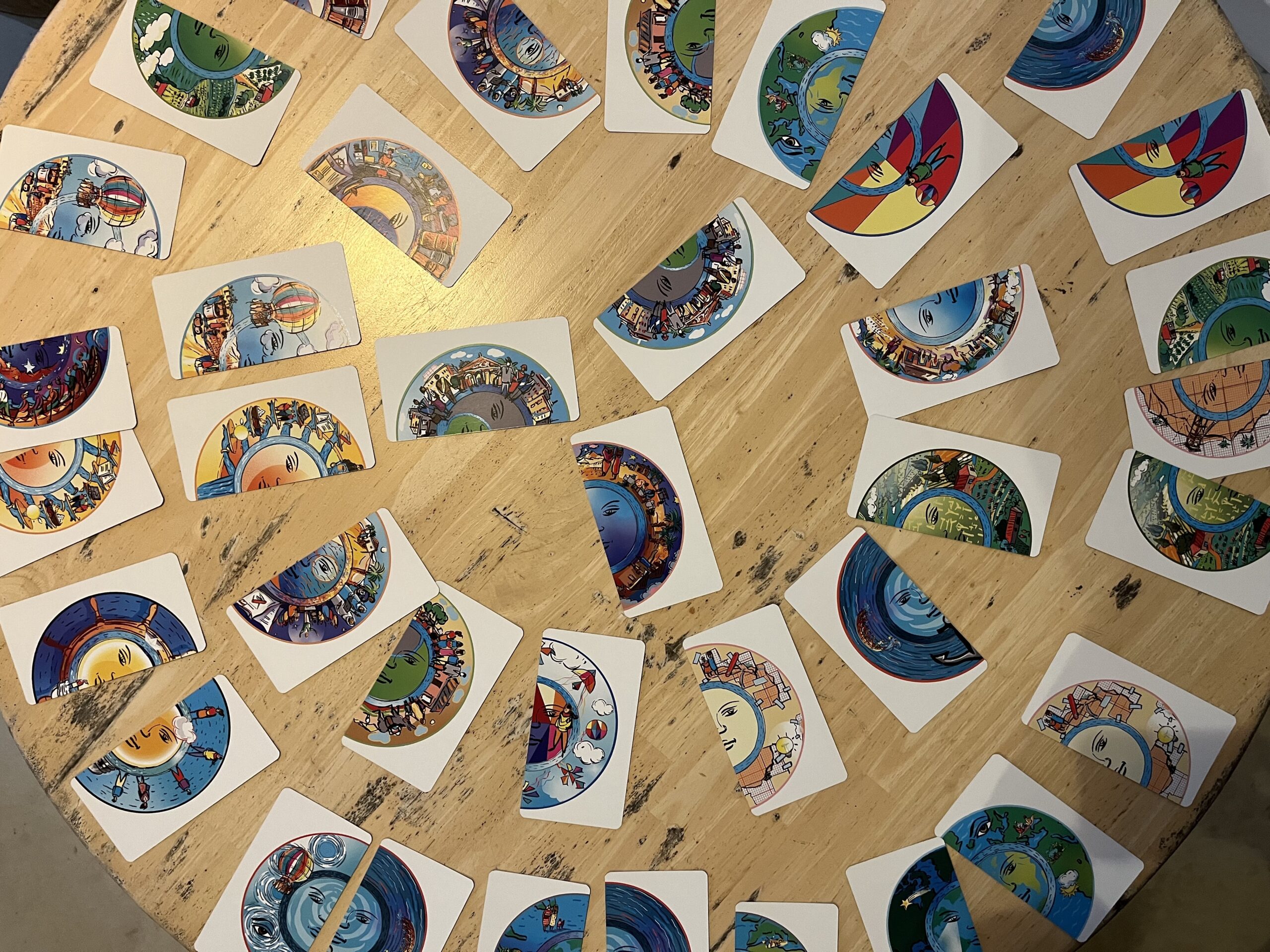
The initial idea behind the “posture game” was to have a suite of same-style illustrations inspired by the heterogeneous collages made by project team members. Underlying this, was the idea of using the graphical self-depiction we made of our research stances and practices and the accompanying texts to elaborate what could be called ideal-types of how researchers relate to ideas of societal engagement and transformation. We turned towards a colleague, Denis Delebecque, who has worked on defining the visual identity of G-EAU and a series of communication products over the last three years, and engaged the discussion with an artist, Nathalie Le Gall who designed some illustrations in that context.
In addition to our collages and texts, we discussed the tarot of radical research (Temper et al., 2019) as a possible source of inspiration and the analytical grid we elaborated around a series of key dualities early in the project and that underpinned our reflection. The tarot of radical research led us to think of the illustrations in terms of cards; the idea of ideal-types was materialized in the form of visages at the center of the cards; and the dualities of the analytical grid lead us to think of cards that would only display half a visage and could be put side to side to form a full visage. The idea of designing cards that could be assembled in myriad ways reflected our observation that research stances and practices result from a combination of multiple factors and of our willingness to avoid being caricatural in representing them. But, ever so slightly, and without realizing at the time, we shifted from a representation of ideal-types inspired by our collages to a representation of the analytical dimensions of the analytical grid.
We felt the first drawings and illustrations gave too much importance to landscape dimensions and were rather disconnected from issues of research stances and practices while we envisioned the cards as a medium to reflect on these, creatively. This led to further discussion to explain our analytical grid and what we aimed to do in the project with Nathalie who, on this basis, proposed new drawings and illustrations centered on a subset of analytical dimensions, which we deemed the most promising to investigate the dilemmas we face (between being selective and inclusive, situated and normative, detached and emotionally bound, or between analysis and engagement, piloting and supporting, institutionalizing and emancipating, topic and methods oriented, planning or patching). The break away from the initial impetus to represent ideal-types was complete. We had initially thought visages at the center of the cards would serve to express the emotions that come to the fore in the collages and their accompanying texts but now that the cards ended up mirroring the analytical grid rather closely, we thought it would be arbitrary to link a particular emotion to a particular facet of research stances or to specific practices. As the number of combinations between emotions and the analytical dimensions we considered was almost endless, and that we did never considered printing them all, we opted for visages that would be rather neutral.
To sum up, each card was linked to a specific analytical notion and cards came as pairs, with the intent to illustrate some of the binaries (associating two notions) that underpin our understanding and analysis of research stances and practices. Some of the symbols found on the cards can echo analytical categories too, hence resulting in cards that combine multiple analytical standpoints – again to avoid a representation that would be too static. These symbols are also printed as standalone tokens, as are a suite of emotions that transpired from the collages and corresponding textual descriptions.
The idea of using the illustrations as a game or, rather, as an elucidation tool inspired by the well know Dixit board game emerged in the process of designing the illustrations (and likely because we used Dixit as an elucidation tool during a project meeting). We conducted several test sessions with an initial set of cards and elaborated different modalities of use. We see these as ideas to be tinkered with rather than a set of fixed rules. These test sessions also led us to revisit the initial illustrations and game set. We simplified some of the cards, often deleting symbols we had added against the background of certain cards in an attempt to show that analytical categories should not been envisioned as standalones but in interaction one with another. Maybe most significantly, and while each illustration initially came either as the left or the right side of a visage (without any rational as to which side), we decided to print two versions of the same illustration: the left and the right side of a visage. This means each visage can be associated to a single analytical notion while, initially, each visage combined two complementary analytical notions, and was hence associated to a “duality” we deemed of interest.
It is clear our analytics have informed the design of the cards but our objective has always been to design something that would be evocative, something people could project their own meanings and feelings into so that they could engage in their own reflexive process and identify the notions that made sense to them (as opposed to us). This is why we prefer not to give “the key” to link the cards and the symbols to the different facets of our analytical grid. With a bit of imagination, this link can be made for sure but rather than thinking too much about what this means to us, we invite people who will use the “posture game” to associate what they see on the cards to things they consider important and meaningful to decrypt their research stances and practices.
The posture game comes free of rights and can be used and adapted by anyone interested. We hope other research collective will use and will happily discuss their experience.
Downloads
- Posture Game: Cards, Facilitation Modalities, and Concept description